OKR vs. OGSM
Which method helps you realize your objective and goals?
OKR, OGSM or a combination?
How do you ensure that your organizational strategy is actually executed? OKR and OGSM are two widely used methods that help teams stay focused and achieve results together. Both give organizations clear direction and focus. In this article we look at OKR and discover that OKR and OGSM are essentially similar.
OKR: objective and results
bjectives and Key Results (OKR) is a method that helps organizations make measurable progress within short periods. The framework consists of two core components:
By using OKRs you make goals explicit and can systematically track progress. Both elements are crucial for actually achieving your ambitions.
From goals to concrete action
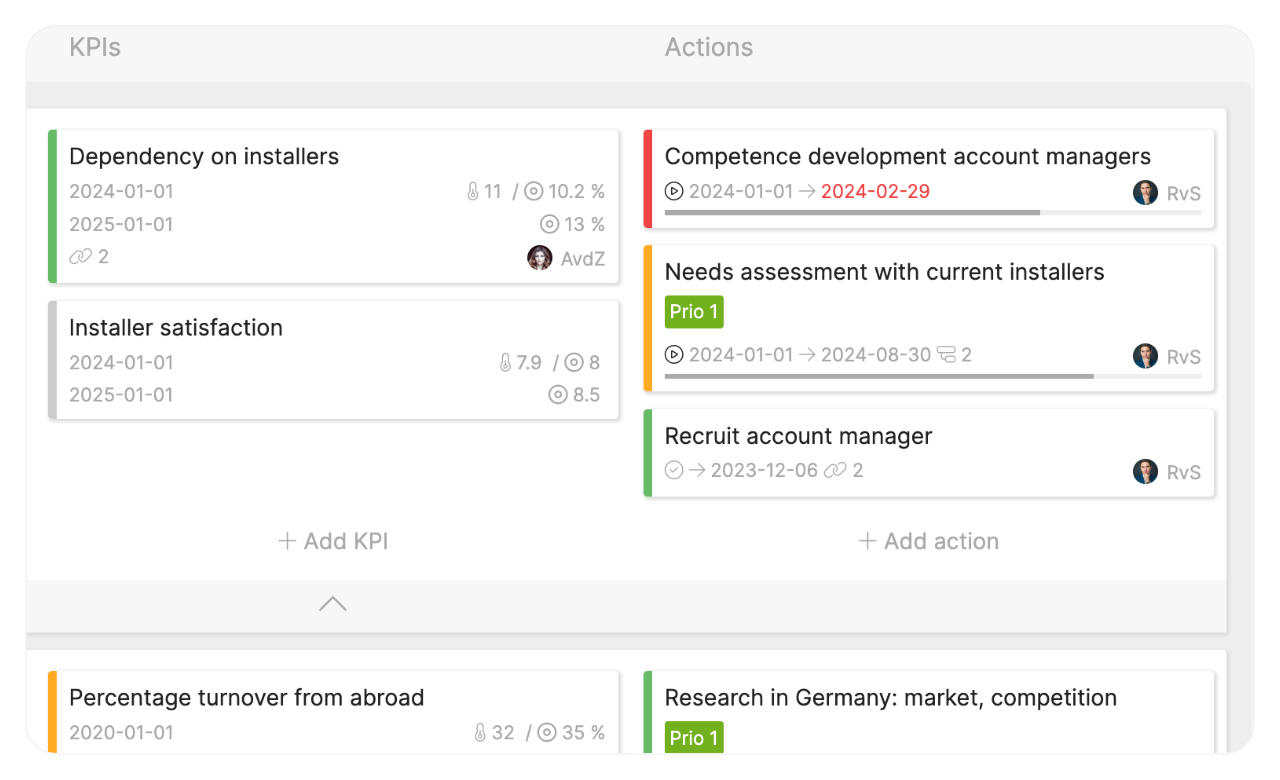
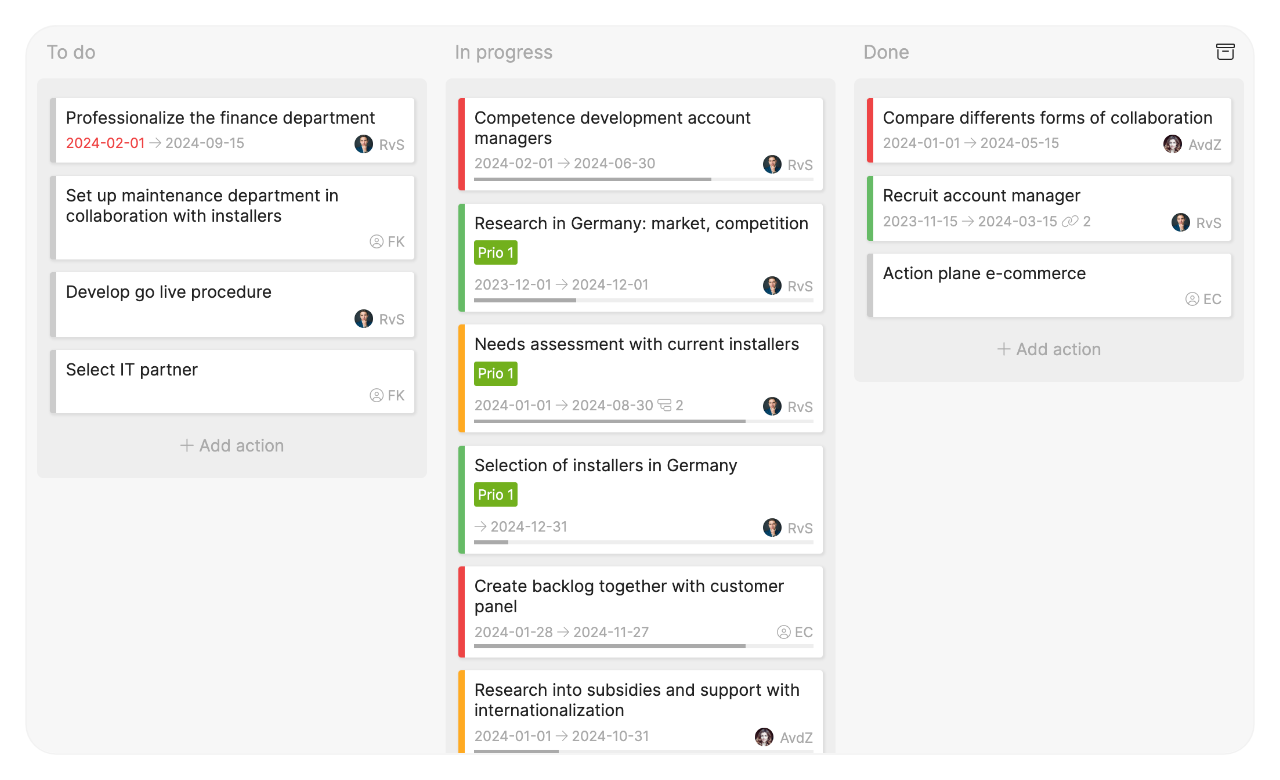
Although OKRs formally consist only of objectives and key results, organizations in practice often add a third component: Initiatives. These are the specific activities that are executed to realize the set results and goals.
Output versus input: Two types of OKRs
The OKR methodology makes an important distinction between output and input:
Both variants have their value. Output-OKRs focus team members on the essence: why are we performing these activities? Input-OKRs, however, are more concrete and practically measurable.
Usually you see that OKRs higher in the organization are more output-oriented, while they become more input-oriented lower in the organization.
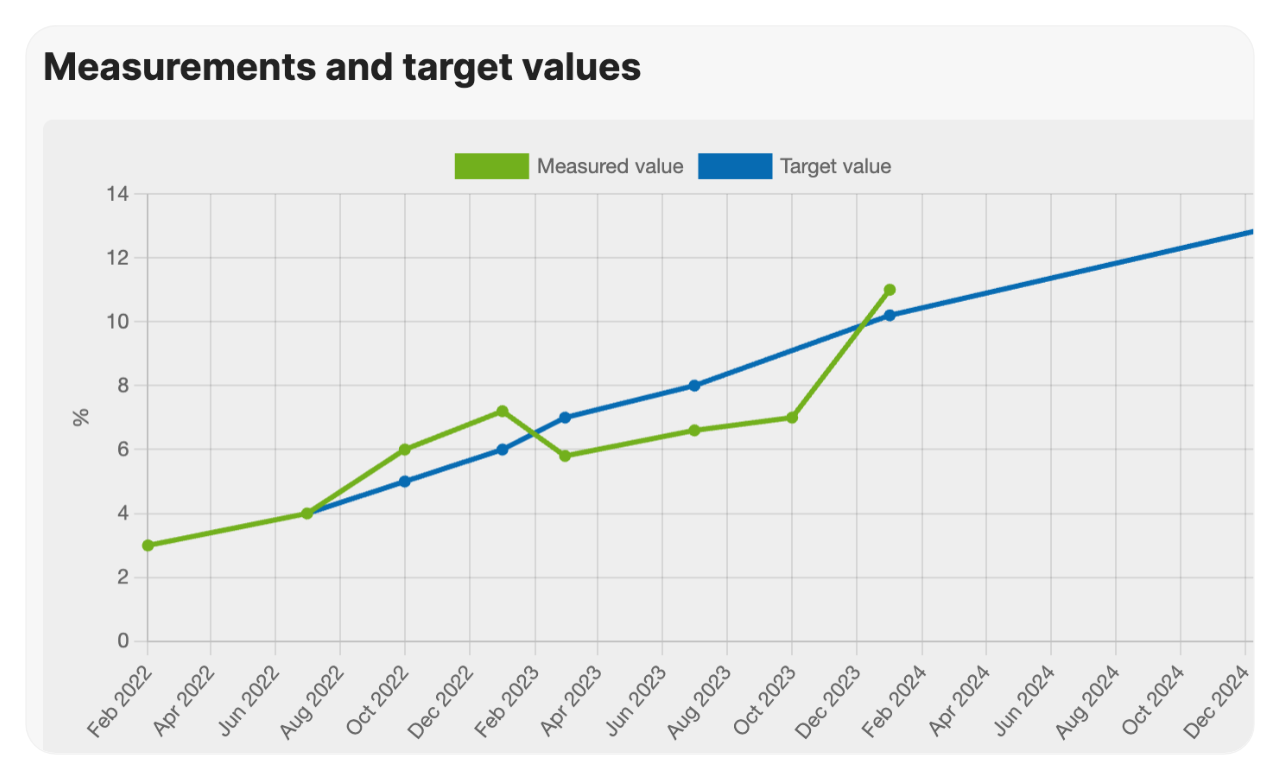
An article on whatmatters.com (the website of OKR evangelist John Doerr) claims that this is a fundamental difference with OGSM. OGSM would mainly contain financial goals. Reality, however, shows something different. OGSM lends itself excellently to combining output and input in one integrated overview. The output is mainly expressed in the goals. The input is reflected in the indicators. Moreover, the goals are never exclusively financial. Customers, employees and sustainability, for example, regularly appear in the goals.
Hard targets and ambitious challenges
An interesting aspect of OKRs is the distinction between “committed” and “aspirational” OKRs. The first category must absolutely be realized. The owner fully commits to the success of this OKR and can be held accountable for it. The second category expresses the organization’s ambition and serves to challenge and motivate stakeholders. There is a chance we won’t reach the goal, but suppose we do succeed…
You can also make this distinction in an OGSM.
Learning and adjusting per quarter
A widely applied rhythm for evaluating and adjusting OKRs are quarterly cycles. Each quarter you determine whether the objectives have been achieved and set the OKRs for the coming quarter. Teams can work on different OKRs in parallel.
During the quarter, for example monthly, you evaluate the progress of the OKR and determine whether the OKR will be continued or needs to be adjusted. This way you learn from your experiences and can respond to changing circumstances.
OKRs are focused on contributing to the organizational strategy, but with a time horizon of (usually) a quarter. OKRs are therefore naturally more agile than OGSMs and fit in an environment with high dynamics.
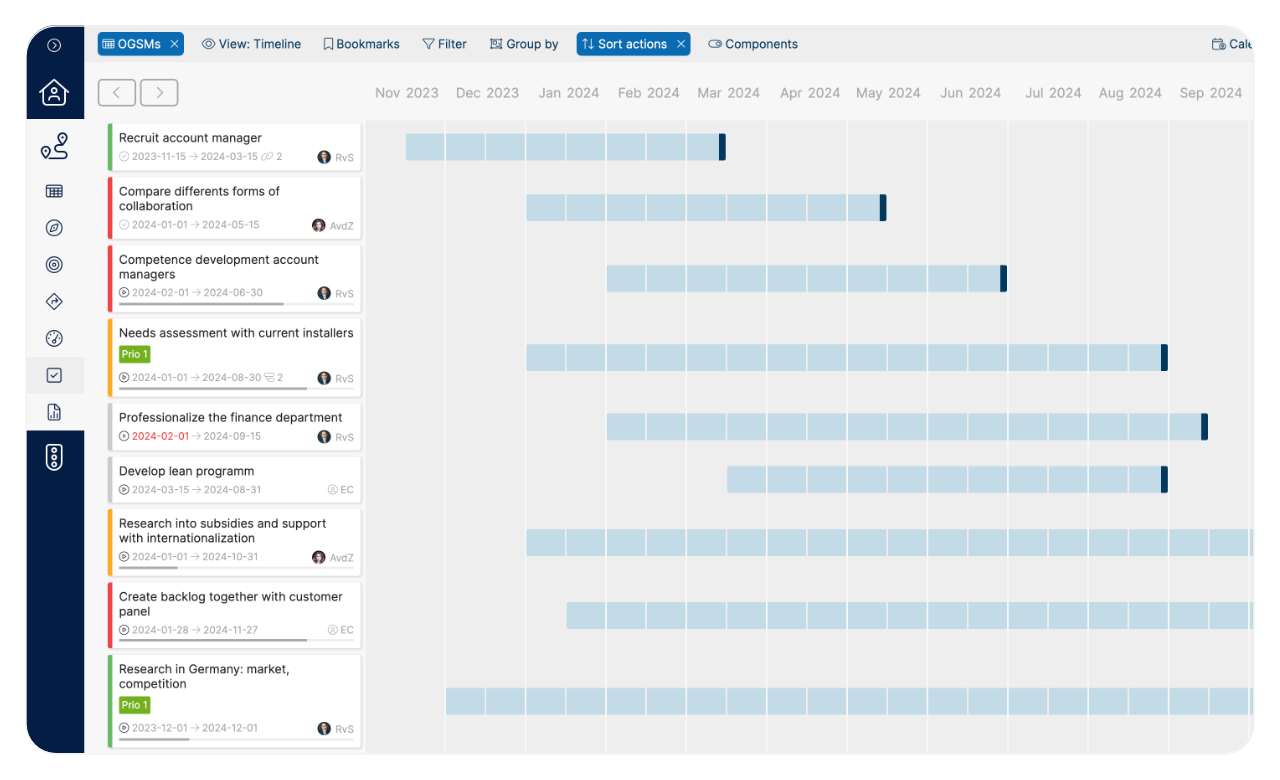
OGSMs are more plan-oriented than OKRs. An OGSM is a developed strategic plan with a time horizon that (usually) lies multiple years in the future. Through its systematic character, OGSM helps prioritize the various activities better. OGSM provides insight into the bigger picture and the connections between strategies. The long-term plan is translated into concrete short-term activities. Through an approach of learning and adjustment, the OGSM remains a living document, so you stay on course while remaining flexible.
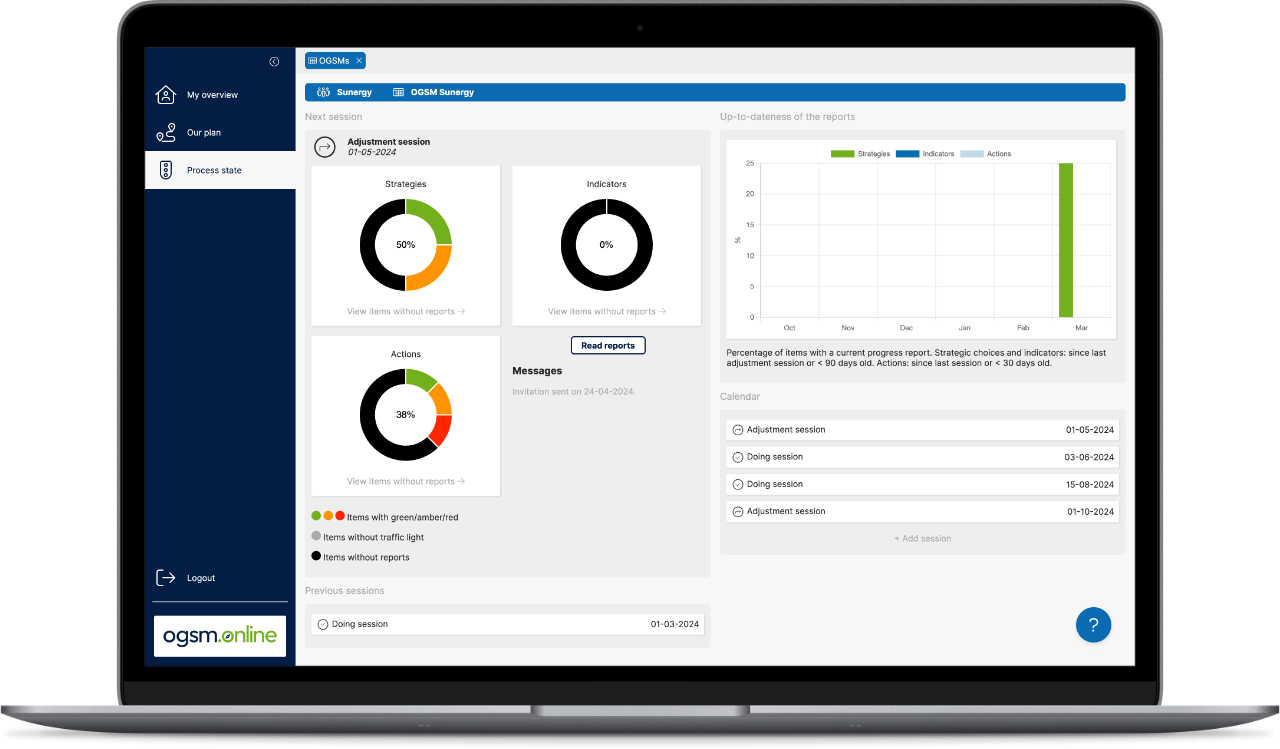
Our approach with monthly and quarterly sessions (Do, learn, and adjust) seamlessly aligns with the OKR approach.
Connections between OKRs in the organization
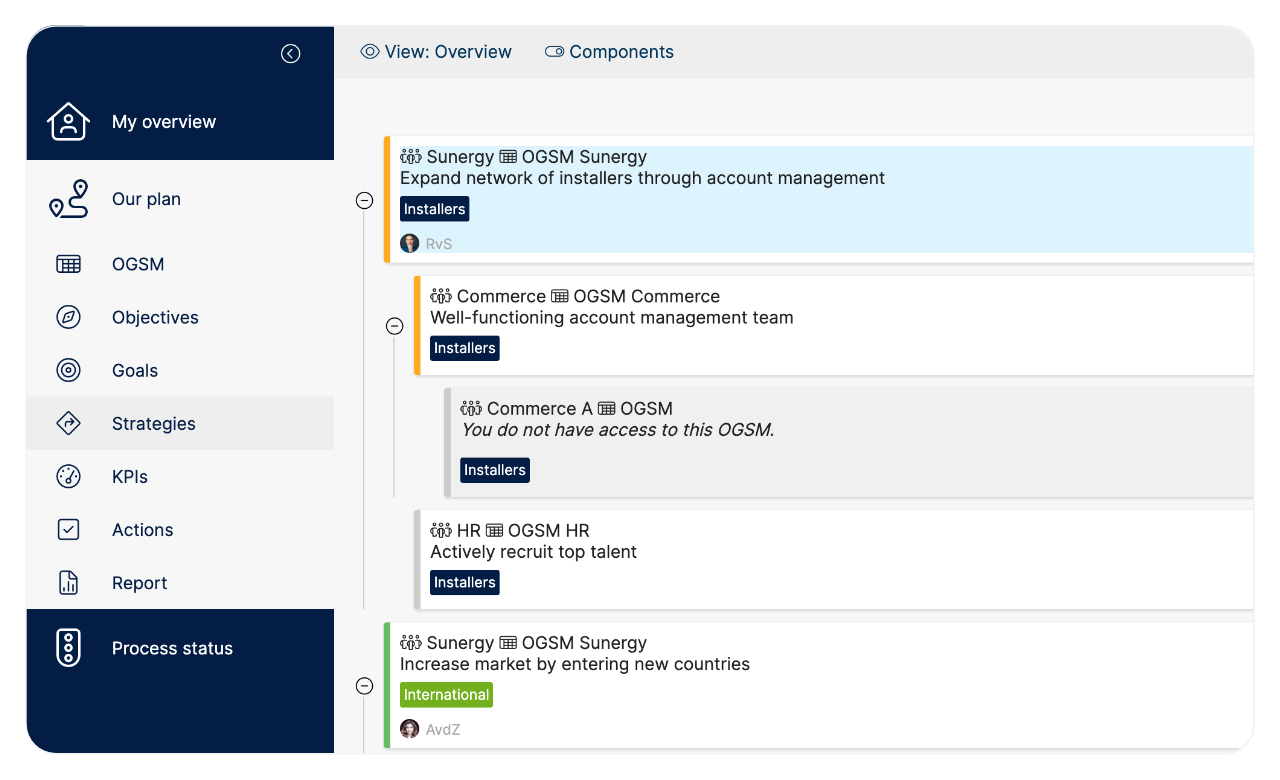
To ensure alignment with the organization’s long-term goals, you can cascade OKRs. That is: translate them to deeper organizational levels. In the example below you see a cascaded OKR that also becomes more input-oriented.
The methodology includes that OKRs are transparent for the entire organization. This stimulates that OKRs deeper in the organization contribute to the bigger whole and that initiatives from different departments and teams are aligned with each other.
OGSMs can be cascaded in a similar way, where the actions from the organization-OGSM become the strategies in the department-OGSMs. However, we prefer cascading based on strategies. The departments determine the formulation of their strategies themselves. In this they describe how they contribute to the organization-OGSM. This creates more ownership and involvement
OKR versus OGSM: mainly similarities
They are two different approaches with the same goal: realizing results. The table below shows the differences and similarities:
| Aspect | OKR | OGSM |
|---|---|---|
| Focus | The objective gives clear focus to stakeholders. | The objective determines the long-term direction. The strategies give focus on shorter term (often a year). |
| From goals to action | You can add initiatives to the OKR. | Actions are an integral part of the OGSM. |
| Progress | With key results you can monitor progress. | The indicators provide insight into strategic progress. |
| Learning and adjusting | Each quarter you create new OKRs. The condition is that they contribute to the mission/vision/strategy. | The OGSM is a living plan. Each quarter you evaluate the results and adjust the plan. |
| Hard goals and big challenges | Both “committed” and “aspirational” OKRs are possible. | For the indicators you can distinguish between hard targets (in OGSM terms: target values of indicators) and “aspirational” goals. |
| Combination of output and input | OKRs can be both output- and input-oriented. | Goals are output-oriented, the indicators both output and input-oriented. |
| Coherence in the organization | Cascading OKRs is possible. | Cascading OGSMs is possible. |
| Systematic vs. flexible | OKRs are very flexible and are created per quarter. In extreme cases this leads to ad-hoc activities. | OGSMs are usually created annually and adjusted along the way. In extreme cases there is too rigid adherence to the plan. |
OKR and OGSM: the best of both worlds
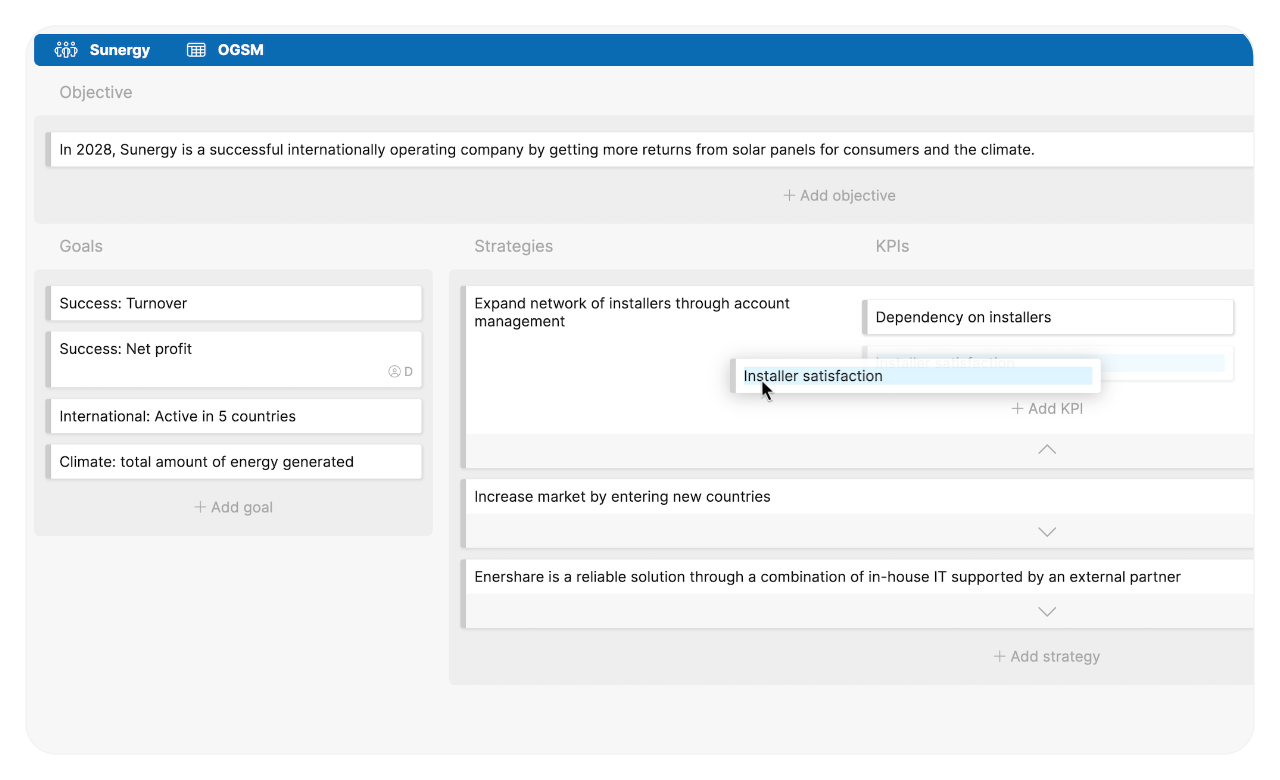
OKR and OGSM are thus different methodologies, but with enormous overlap. It just depends on how you apply the method. In the figure below you see how OKR and OGSM can coincide:
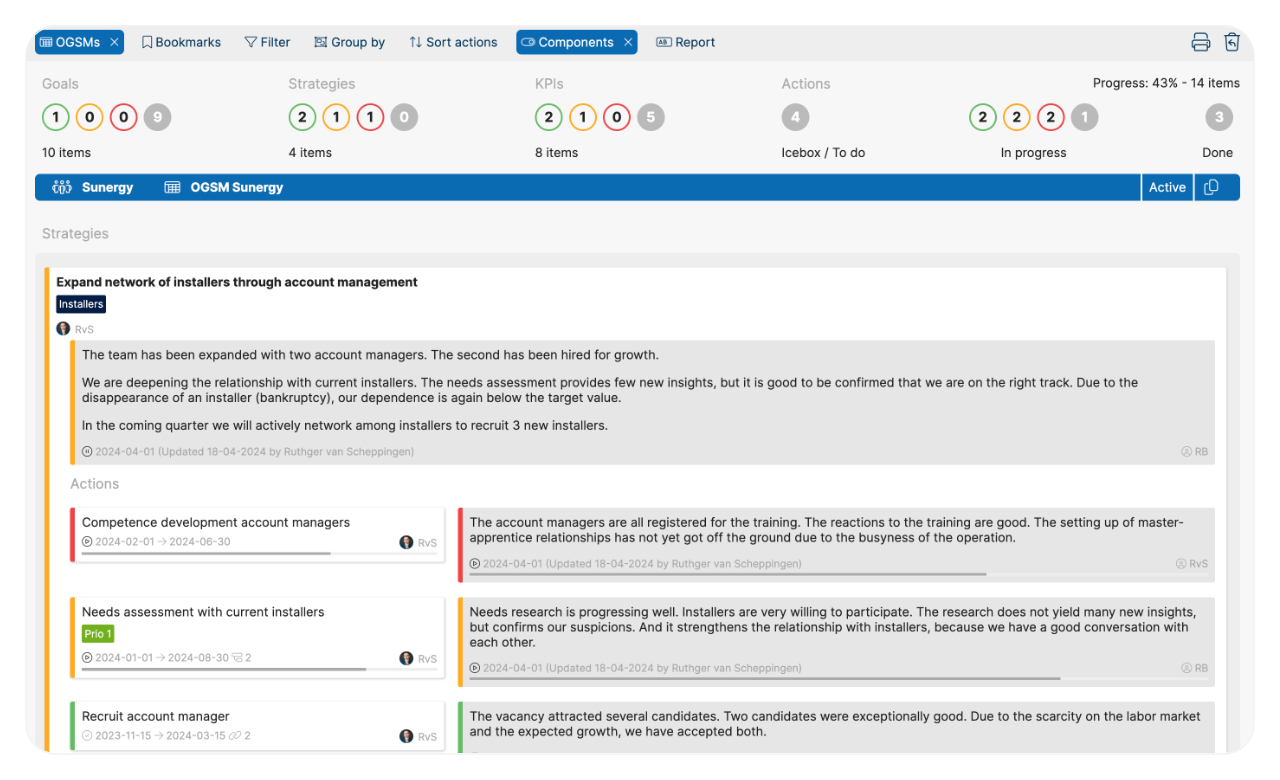
At the organizational level, planning is strategic. The emphasis in the OGSM lies on the objective, goals and strategies. For underlying departments and teams, the emphasis lies more on the strategies, indicators and actions. These plans are more tactical and operational in nature. In practice we also see that deeper in the organization, separate objectives and separate goals are not always formulated. You could therefore say that only OKRs are developed here.
In this way, OKR and OGSM are not two different methodologies, but two approaches that reinforce each other. Where focus on the longer term is important, you use the complete OGSM. Where that is less relevant, you leave the objective and goals empty, or use the overlying content.
Conclusion: essentially no difference
OKR and OGSM are fundamentally the same methodology with different labels. Whether you work with Objectives and Key Results or with objective, strategies, indicators and actions, the underlying logic is identical. Both methods help organizations move from strategy to execution through clear goals, measurable results and concrete actions.
For organizations already working with OKR, this means that the transition to OGSM tooling proceeds smoothly. You don’t need to learn a new way of thinking – you simply use different terminology for the same concepts. OGSM may offer more possibilities for long-term planning and strategic coherence, but the core of your OKR process remains fully intact.
Concrete plan. More results.
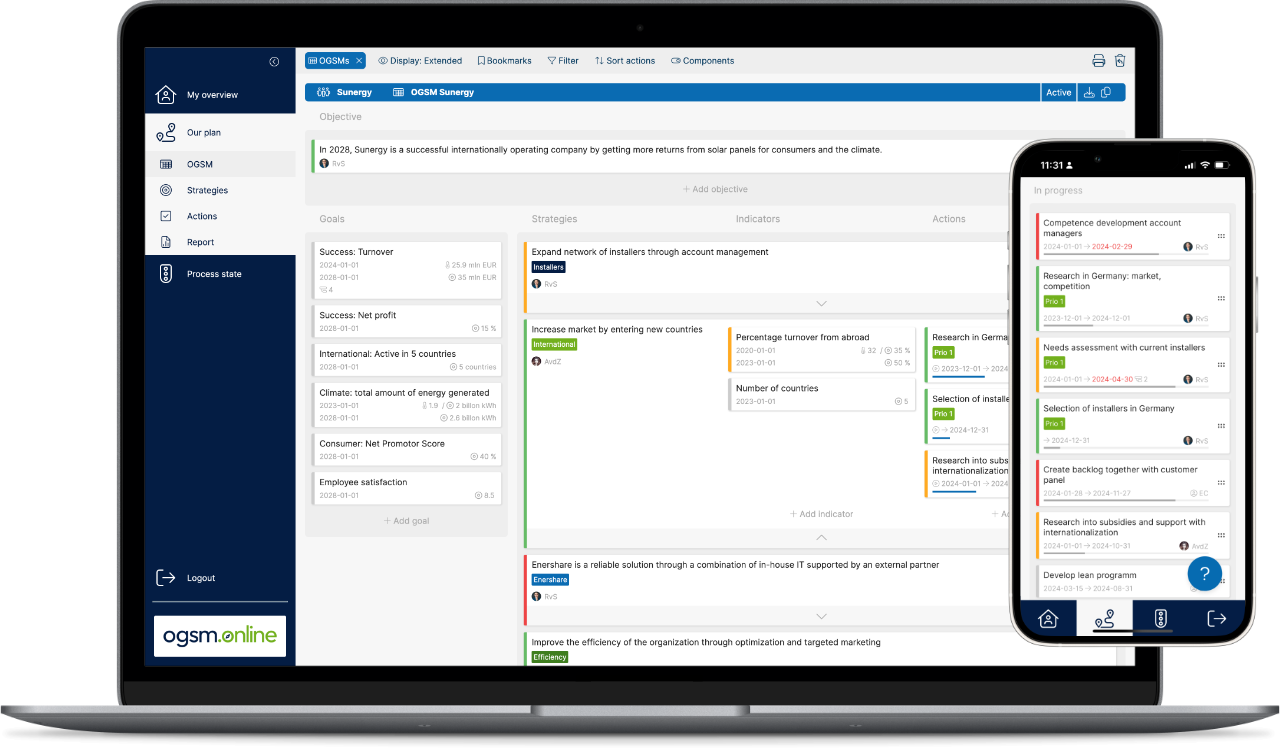
OGSM.online is the online tool for creating and monitoring OGSM plans.

Creating OKRs and OGSMs