
OGSM: simple, but not easy
Three success factors for achieving real results with OGSM.
A plan on one page. That sounds simple and clear.
And it is. But don’t be fooled: creating a solid OGSM plan and actually steering with it takes quite a bit of effort. In this article, we show what it takes to achieve real results with OGSM, and why you don’t have to do it alone.
The power of a good plan
Imagine: your team starts the new year with a clear plan. Everyone knows where you’re headed and which choices you’ve deliberately made. During execution, it’s obvious what needs to happen, because it’s all in the plan. And when results fall short or exceed expectations, you can learn from them and adjust. The plan keeps improving and always stays current.
That’s the promise of OGSM. And it holds true, provided you approach it properly. Because a plan is not a static snapshot you take at the start of the year and then file away. It’s a film, with new plot twists appearing constantly. The art is to steer those plot twists deliberately, rather than being swept along by them.
Steering on progress and results
Working with OGSM ultimately comes down to two questions every team must ask itself regularly:
“Are we doing things right?” In other words: are the actions on track? Are we on schedule? Where are we getting stuck, and how do we solve that?
“Are we doing the right things?” In other words: are our actions actually delivering the results we expect? Are the KPIs moving in the right direction? Or do we need to adjust the plan?
The first question is about progress. The second is about results. Both are essential. A team that only steers on progress may be working very hard on the wrong things. A team that only looks at results misses the signals from execution that explain why something is or isn’t working.
Three success factors
In practice, we see that organizations that work successfully with OGSM have three things in order. They reinforce each other, and you need all three.
1. A sharp plan
Everything starts with a good plan. That means: a clear Objective, concrete Goals, focused Strategies, and well-defined Actions. No grand narratives or vague buzzwords, just deliberate choices that provide direction. Making choices is always uncomfortable, but that’s precisely what makes your plan powerful.
OGSM is the ideal framework for creating such a sharp plan. It forces you to be concrete: every word that can be removed is cut, every choice has an owner, every Action has a deadline. And when there are multiple plans within the organization, OGSM ensures coherence. From organizational strategy to departmental plan, everything connects logically and reinforces the whole.
2. A clear way of working
A plan without a way of working is like a roadmap without a car. You know where you want to go, but you never get there. Teams that work successfully with OGSM have a structured approach for discussing execution, learning from progress, and adjusting where needed.
We call this “Do, learn, and adjust.” The total duration of the plan is broken into smaller, manageable periods. During each period, you track progress through action review sessions (are we doing things right?) and evaluate results through strategy review sessions (are we doing the right things?). This creates a rhythm of deliberately executing plans, learning from them, and refining the plan.
Want to know more about this approach? Read the article on Do, learn, and adjust.
3. Overview and insight
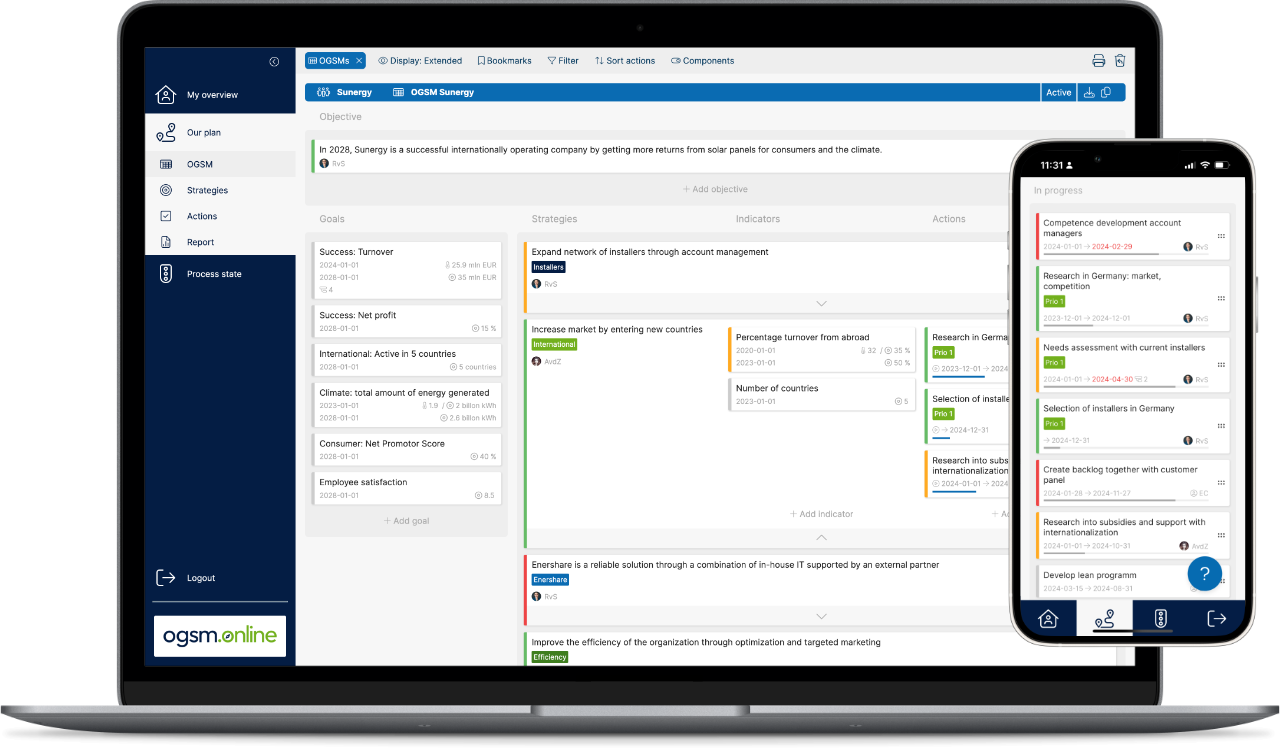
The third success factor may be the most underestimated: overview and insight. Teams need to see at a glance what the plans are, how actions are progressing, and how the results (KPIs) are developing. Without that overview, you don’t know what to discuss in your action review and strategy review sessions. And without insight into results, you can’t improve the plan.
Here’s the beauty: the three success factors reinforce each other. Overview and insight (3) ensure you have the right conversations in your way of working (2). Those conversations lead to better choices, which sharpens your plan (1). And a sharper plan provides clearer overview in return. It’s a flywheel that keeps spinning faster.
Concrete plan. More results.
OGSM.online is the online tool for creating and monitoring OGSM plans.
The golden rules
The book “Bridging Strategy and Execution” sets out a number of golden rules that directly align with these success factors:
OGSM is your compass, GPS, roadmap, and checklist. The Objective and Goals set the destination, the Strategies define the route, and the Actions tell you what to do. Use the model fully, not just for the plan, but for steering as well.
OGSM is simple, but not easy. It’s a powerful framework, but not a magic bullet. A plan on one page seems quick to write, but making sharp choices and formulating them concretely is hard. Don’t be discouraged.
Make someone responsible for the process. Appoint a process owner so the team can focus on content rather than on organizing sessions and tracking progress.
Document the process and stick to it. Set the rhythm of your action review and strategy review sessions and schedule them in the calendar for the entire plan period. It may feel like a straitjacket, and that’s fine. That discipline is exactly what you need.
The OGSM is sacred. If it’s not in your OGSM, you don’t do it. But in your strategy review sessions, you have every opportunity to deliberately revise your plan.
The tool and the mastery
OGSM.online provides the tool: a platform for creating sharp plans, monitoring progress, and making results visible. With OGSM.online, overview and insight (success factor three) are always within reach.
But good tools alone are not enough. You also need mastery. And that’s exactly what our partners deliver. They are experts in the OGSM method, in training teams, facilitating sessions to create sharp plans, and establishing a way of working to steer with them. They bring years of experience applying OGSM in multinationals, SMEs, healthcare organizations, government bodies, and more.
We provide OGSM.online. Our partners provide the expertise. Together, we ensure that your organization doesn’t just have a good plan, but actually achieves results with it.
Want to know what OGSM can mean for your organization? Get in touch with one of our partners.